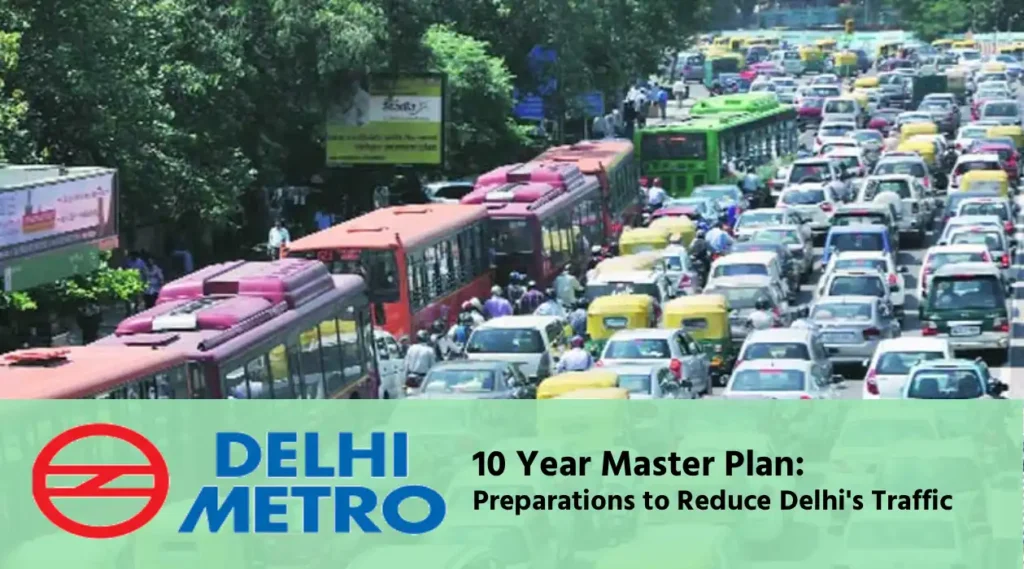
DMRC (Delhi Metro Rail Corporation) in reply to the continuously rising traffic congestion in the national capital Delhi has come up with a detailed 10 year master plan running between the year 2027 and 2037. The plan will not only assist in the minimization of traffic jams on the roads in the city, enhance the public transport, and offer quicker, safer and more convenient & eco- friendly means of transport.
Key Features of the 10 Year Master Plan
Expansion of New Metro Lines: DMRC is planning to expand the metro network in the Delhi and NCR region, current 389-kilometer network targeted to reach 450 kilometers by 2027, including new lines in areas like Gurugram, Noida, Faridabad, and Ghaziabad. With new lines and extensions, millions of people will shift from road to metro every day. Traffic burden will be reduced on several major routes.
Expansion of Interchange Stations: The new 10 year master plan suggests the development of some important interchange stations, which will enable passengers to change their line to the other one without any inconvenience. This will reduce the need for autos and taxis even for short distances on the road.
Expansion of Park and Ride Facilities: DMRC will develop park-and-ride facilities at major stations, allowing people to park their vehicles at the station and easily access the metro within the city. This is expected to reduce the number of cars in the city’s core areas.
Green Transport and E-Mobility Services: DMRC will increase the number of electric buses and e-rickshaw-based feeder services in the coming 10 years. This move will promote ‘Green Transport‘ and reduce pollution in congested areas. Energy-efficient technology and sustainable infrastructure will be used, keeping the environment in mind.
Smart Technology and AI-Based Management: The new master plan will apply AI and IoT technology in train operations, maintenance, and passenger management. For example, smart signaling systems will allow speed-up trains, making traveling time shorter. Furthermore, renewable energy will be aggressively used and promoted under the net-zero emission goal. DMRC currently shares 35% of its electricity with solar energy.
Smart Ticketing System: Digital payments and face recognition-based entry will be integrated into the cards for a more seamless passenger experience.
Congestion Reduction Strategy: Additional trains and faster frequencies will be implemented on busy routes.
Benefits for Citizens
This 10 year master plan will provide Delhiites with fewer traffic jams, less pollution, and a better travel experience. Experts believe that- the extension of the metro network will reduce dependence on private vehicles and alleviate Delhi’s traffic congestion in the future. Strengthening the metro network will reduce the use of private vehicles and reduce travel time. If Metro is expanded and last-mile connectivity is improved, life in the city will become easier.
Financial Sustainability and New Opportunities
A key part of the 10 year master plan is ensuring the financial strength of the DMRC. Besides ticket income, the revenue will be produced based on the land monetization, Transit Oriented Development (TOD), and innovative financing models. The consultant will make a SWOT (Strengths, Weaknesses, Opportunities, Threats) analysis and compare the DMRC with global metro systems (like the COMET network) to implement the best practices in safety, customer satisfaction, and operation.
In addition, the DMRC will expand into new areas such as Mobility as a Service (MaaS) platforms, NCR-wide integrated solutions, and international consultancy. The Vision 2035 document will set out long-term goals, mission, and values, which will be aligned with India’s Vision 2047 and the NCR Planning Board’s Vision 2041.
DMRC’s Goal: Delhi Became India’s well Planned Transit City
DMRC officials stated that- their goal is to make Delhi India’s fastest, safest and most connected public transport city over the next decade. The plan will be developed with 3-year and 5-year strategies, focusing on human resource development, employee training, and gender equality. By 2026, construction is projected to be completed in stages assisting in making Delhi a global mobility hub.
Conclusion
This 10 year master plan vision by DMRC is a major step towards making Delhi a smart and sustainable transport hub. This scheme will not only reduce the traffic but also lay the foundation of making Delhi-NCR a green, efficient, and inclusive city. This move by DMRC raises hope that the roads in the capital would give a sigh of relief by the next decade.