
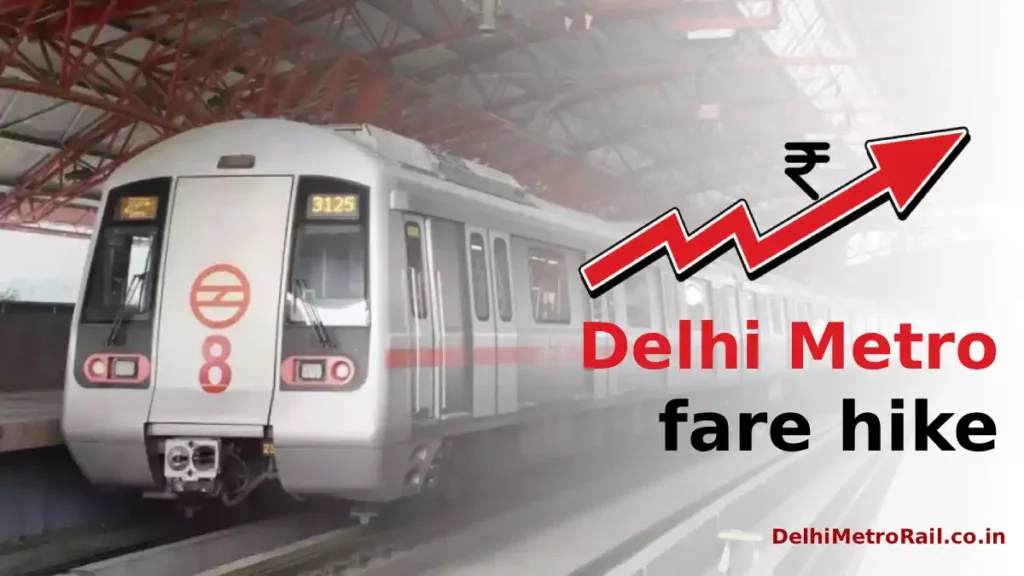
After 8 years of stable pricing, the Delhi Metro Rail Corporation (DMRC) has officially announced a metro fare hike across all lines, effective from April 1, 2025, sparking widespread discussion in the capital. This marks the first revision since 2017, with increases ranging from ₹1 to ₹4, and up to ₹5 on the Airport Express Line. The price increase is aimed at tackling rising operational costs and funding ongoing infrastructure projects under Phase 4 expansion.
Metro Fare Hike Details- What’s Changing?
According to the revised structure, the minimum fare will increase by ₹5. The new updated metro fares will apply across all lines, with the minimum ticket costing ₹11 and the maximum ticket costing ₹64 for the longest journey.
Under the New Metro Fare Hike Structure:
- 0–2 km: ₹11 (earlier ₹10)
- 2–5 km: ₹21 (earlier ₹20)
- 5–12 km: ₹32 (earlier ₹30)
- 12–21 km: ₹43 (earlier ₹40)
- 21–32 km: ₹54 (earlier ₹50)
- Above 32 km: ₹64 (earlier ₹60)
Daily commuters, especially office-goers and students, are expected to feel the pinch of the hike. On Sundays and National Holidays, discounted slabs apply, with fares starting at ₹11 and capped at ₹54.
On Sundays and National Holidays, Off-Peak Usage:
- 0–2 km: ₹11
- 2–5 km: ₹11
- 5–12 km: ₹21
- 12–21 km: ₹32
- 21–32 km: ₹43
- Above 32 km: ₹54
For the Airport Express Line, increases vary from ₹1 to ₹5 based on distance, with the minimum fare remaining at ₹10 in some cases but maximums adjusted upward.
Examples of impacted Metro Routes include:
- Noida City Centre to Rajiv Chowk: Now ₹43 (earlier ₹40).
- Noida City Centre to Dwarka Sector 21 (Blue Line): Now ₹64.
Smart Card Discounts and Concessions Still Apply
DMRC confirmed that Smart Card users will continue to receive a 10% discount on all metro fares, with an additional 10% Off during off-peak hours—before 8 AM, between 12–5 PM, and after 9 PM.
Concessions from DMRC
- Students: 50% discount on monthly passes
- Senior Citizens: 40% discount during off-peak hours
- Divyangjan: Free travel with valid ID
Discounts and Ways to Save Metro Fare Hike
To soften the blow, DMRC offers several incentives:
Smart Card Users: A standard 10% discount on all fares, plus an extra 10% (total 20%) during off-peak hours (before 8 AM, 12 PM-5 PM, and after 9 PM).
Multiple Journey QR Ticket (MJQRT): Similar 20% off-peak discount, available via the DMRC app.
National Common Mobility Card (NCMC): 10% off during peak hours and 20% off-peak.
Tourist Cards: Unchanged at ₹200 (1-day) and ₹500 (3-days), including a refundable deposit.
Tickets can be purchased online through the DMRC Travel App, third-party apps, or even WhatsApp by messaging “Hi” to +91 9650855800 for a QR code. Notably, there are No Free rides for Women or Students, though the First Coach of every train is reserved for Ladies and the Disabled.
Reason Behind the Metro Fare Hike
DMRC officials explained that the fare adjustment was necessary to balance high electricity bills, staff salaries, and maintenance costs. With the metro network expanding rapidly under Phase 4 projects, the corporation has also stressed the need for sustainable revenue to ensure smooth operations.
Conclusion
The Delhi Metro fare hike may be pricking commuters in the short term but is aimed at maintaining and improving services in the long run. While some commuters see the metro fare hike as a necessary step to balance operational costs, others argue it adds pressure to already stretched budgets. For now, switching to smart cards or off-peak travel could help mitigate costs – but for many, the daily grind just got a bit pricier.