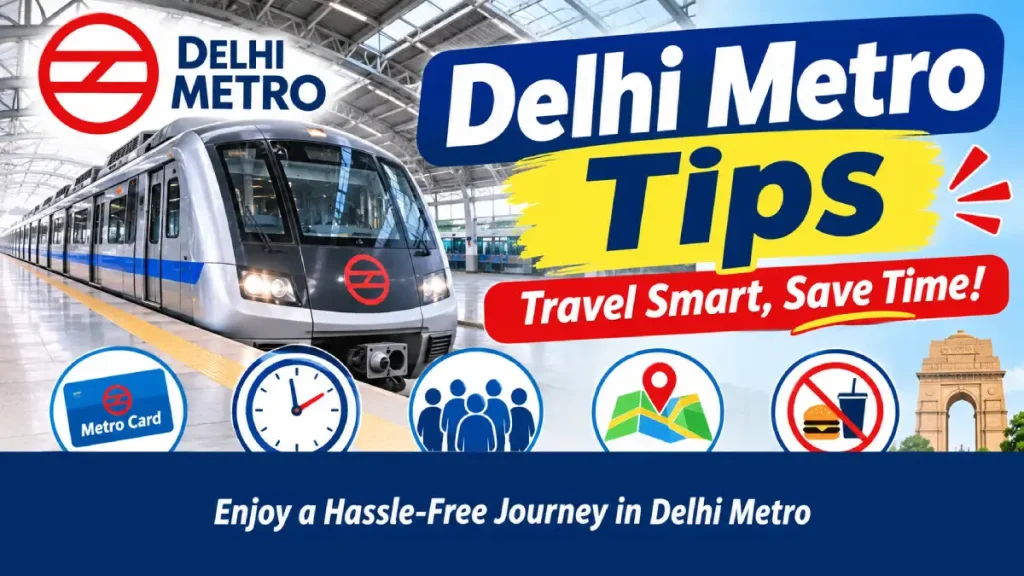
Delhi Metro is one of the most convenient and faster modes of transport in the city of Delhi and the wider NCR. With multiple lines, hundreds of stations, interchange points, various forms of ticket options and links to major locations, Delhi Metro can make daily travel easier.
But when travelling by metro for the first time riders can sometimes make simple mistakes- board the wrong train, choose an unnecessary interchange, buy the wrong ticket, enter through the wrong gate or wrong platform, underestimate walking time at large stations etc. So, here are 10 practical and useful Delhi Metro Tips that can help you save time & money, avoid common mistakes and make your journey smoother.
Table of Contents
10 Delhi Metro Tips to Save Time, Money and Mistakes
Delhi Metro has become the lifeline of the capital, connecting all corners of the city in a speedy and affordable manner. Whether you are a commuter, a student, a tourist or someone visiting Delhi for the first time, these key Metro Tips will help you use the metro more effectively.
1. Plan Your Delhi Metro Route Before You Travel
An easy way to save time is to plan your entire metro journey before you reach the station. Delhi Metro has an extensive network, and sometimes two stations can be connected by multiple routes. Not every time is the fewest stations to reach the shortest route; sometimes a route that has one station can save you an interchange and make the metro journey easier.
Example if:
- Route A: More stations but no interchange
- Route B: Fewer stations but one interchange
Before starting your metro, always check:
- Your starting metro station
- Your destination station
- Metro line or lines required
- Interchange stations
- Direction of travel
- Approximate journey time
- Number of stations
- Walking distance at interchanges
- Suitable exit gate at your destination
In case you are a passenger with luggage, have kids or are not familiar with Delhi Metro, then Route A may be easier though a bit longer.
Pro Metro Tips: Don’t simply look for the destination station. Check the entire route and interchange stations points before you ride the metro.
2. Always Check the Train Direction
A common mistake made by new metro riders is boarding a train going in the wrong direction. Metro platforms usually show the end station or the direction the train heads. Don’t assume the colour of the line, look at the destination indicated:
- Platform signs
- Electronic displays
- Train information boards
- Station announcements
Simple Metro Tips–
- Line = which metro route you need
- Direction = which side of that route you need to travel
Checking both line and direction before you board can save you from travelling many stations the wrong way.
3. Choose the Right Delhi Metro Ticket Option
Choosing the appropriate metro ticket can make your journey more convenient and depending on how frequently you travel, potentially more economical. Passengers may use different options depending on the journey and current facilities, including:
- QR-based tickets
- Metro smart cards
- Other supported digital/payment options
- Applicable passes or travel products
For occasional travelling, a QR ticket may be useful as there is no requirement to store an actual ticket.
For regular commuters, a smart-card based system might be more convenient because they won’t have to buy a new ticket for each trip.
Use Smart Cards- Consider, instead of purchasing tokens as needed, using a smart card. It can save you from a long queue and provide a 10% fare discount. It can be recharged online or at stations making it hassle-free. This makes the process easy and simple. The smart card is convenient, useful and a choice.
Note: Ticketing facilities, discounts, fares and payment options can change, so we suggest you check the latest official information before relying on a particular option.
4. Use Digital Payments and Mobile Ticketing Where Available
Another time-saving measure that can be implemented to use digital ticketing and supported electronic payment methods. Depending on the current facilities and station, passengers may buy tickets digitally, rather than at a ticket counter.
This can be particularly useful during:
- Morning rush hours
- Evening peak hours
- Weekends
- Festivals
- Major events
- Tourist seasons
Money-Saving Metro Tips: Avoid purchasing travel products because it seems cheaper. First calculate how many journeys you actually have to make.
5. Avoid Unnecessary Metro Interchanges
Interchange stations are very convenient, because they enable a link between various metro lines. But unnecessarily changing lines can make your trip longer and more complicated. Every interchange can involve:
- Walking between Platforms
- Following Signs
- Escalators or Stairs
- Crowded Corridors
- Additional travel time
If two routes take nearly the same time, the route with fewer interchanges may be more comfortable.
When an Interchange Is Worth It
An interchange makes sense when it:
- Significantly reduces travel time
- Provides a much more direct route
- Avoids road traffic
- Connects you to an important destination
- Makes the overall journey more convenient
Know the Interchange Stations
Interchange stations can be tricky. Rajiv Chowk, Kashmere Gate and Hauz Khas are crowded and have multiple platforms. Follow signage carefully to avoid boarding the wrong train.
6. Understand Delhi Metro Interchange Stations
For first-time passengers, Interchange stations can be confusing. An interchange station, where you can change from one metro line to another, without exiting the metro network system.
At an interchange, don’t simply follow the crowd. Look for changing Signs:
- Line colour
- Line name
- Destination direction
- Platform number
- Connecting line
- Exit gates
What to Do at an Interchange
When you leave your train:
- Check the signs for your connecting line.
- Confirm the direction of your next train.
- Follow the interchange signs.
- Check the platform information.
- Confirm the train’s final destination before boarding.
Note: Some interchange stations can involve a lot of walking. If you are travelling with heavy luggage, young children and elderly people, factor this into your route planning.
7. Avoid Peak Hours If Your Schedule Allows
Delhi Metro can become extremely crowded during office and school/college commuting hours. Between 8-10 AM and 6-8 PM, trains are overcrowded. If possible, travel outside these hours to save time and avoid stress.
Typical busy periods often include:
- Morning Office Hours
- Evening Return Hours
- Weekdays
- Major Events
- Festival Periods
But What If You Must Travel During Peak Hours?
If you cannot avoid peak hours:
- Reach the station a little early.
- Keep your ticket/card ready.
- Stand behind the Safety Line.
- Allow passengers to Exit before entering.
- Keep luggage close to you.
- Avoid blocking doors.
- Follow staff instructions.
If your schedule is flexible, travelling outside the busiest periods can make your journey considerably more comfortable.
Metro Tips: Don’t wait directly in front of the train doors. Move inside after boarding so other passengers can enter safely.
8. Choose the Correct Exit Gate
This is one of the most underrated Delhi Metro time-saving tips. You can reach the correct metro station but still lose 10-20 minutes or more if you exit from the wrong gate and then have to walk around the station. Large metro stations can have multiple exits leading to different roads, landmarks and neighbourhoods.
Why Exit Gates Matter
The correct exit can put you closer to:
- Shopping Markets
- Bus Stops
- Offices
- Hospitals
- Colleges
- Tourist Attractions
- Railway Stations
- Residential Areas
- Major Roads
The wrong exit may leave you on the opposite side of a busy road.
Best Practice: Before leaving the train or station, check which is the closest Gate Number to your final destination. If you are travelling to a landmark, look for the recommended metro exit, not just the station name.
Time-Saving Formula: Correct Station + Correct Exit = Much faster Last-mile Travel.
9. Keep Your Ticket, QR Code or Smart Card Ready
One of the most surprisingly common mistakes is looking for the ticket or phone at the entry/exit gate. During peak times, even a few seconds can cause a small queue behind you.
Before approaching the gate:
- Keep your QR ticket accessible.
- Keep your Smart Card ready.
- Make sure your Phone Screen is active if required.
- Avoid keeping the ticket buried inside a bag.
- Check that your ticket is valid for the journey.
For Smart-Card users, make sure there is sufficient balance or that the card is functioning proper.
What About Your Phone Battery?
If you rely on a mobile ticket, route map or navigation application, a low battery can cause unnecessary problems. Carry a Power Bank if you know you will be travelling for several hours. This is especially useful for tourists and visitors unfamiliar with Delhi.
Keep Change for Tokens
If you don’t have a Smart Card, carry small change for Tokens. This saves time at counters and avoids delays.
10. Check Metro Updates Before Leaving Home
The Delhi Metro network is extensive and constantly evolving. Temporary changes can occur because of:
- Maintenance work
- Construction
- Special events
- Security arrangements
- Service disruptions
- Station closures or restricted access
- Changes in operating arrangements
Therefore, don’t depend completely on an old route screenshot or outdated article.
Check the latest metro information before starting an important journey, especially if the journey goes to an Airport, a Railway Station, an Exam Centre or a time‑sensitive Appointment.
For official updates, you should refer to Delhi Metro Rail Corporation (DMRC) channels.
Why This Matters
A route that worked last month perfectly, today it may have a restriction.
Prevention is better than Cure– A few minutes spent on checking before leaving can prevent a much bigger problem later.
Conclusion
Delhi Metro is one of the most speedy and affordable ways to travel around the city. Following the Delhi Metro Tips- by using smart cards, planning your route and following the rules, you can save time, money and avoid making common mistakes.
Frequently Asked Questions
What is the best way to save Time on the Delhi Metro?
Plan your route before travelling, choose the correct direction, avoid unnecessary interchanges and identify the correct exit gate in advance. These simple metro tips can significantly reduce unnecessary walking and waiting.
How can I save Money while travelling by Delhi Metro?
Choose the metro ticket or travel option according to how frequently you travel, avoid unnecessary trips and consider public transport for your last-mile journey instead of automatically taking a cab.
How do I avoid boarding the Wrong Delhi Metro train?
Check the line, direction and terminal station displayed on the platform and train information boards before boarding.
Is it better to avoid Interchange Stations?
Not necessarily. Interchanges are essential for many journeys. However, if two routes have similar travel times, a route with fewer interchanges may be more convenient.
What should first-time Delhi Metro passengers know?
First-time passengers should understand the metro line, train direction, ticketing process, interchange stations and exit gates. Planning the route before entering the station makes the journey much easier.
Should I travel during Delhi Metro Peak hours?
You can, but trains and stations can be significantly more crowded. If your schedule is flexible, travelling outside the busiest periods can provide a more comfortable experience.
How can I find the correct Delhi Metro Exit?
Check station Signs and Destination information to identify the gate closest to your final destination. Planning the exit gate before leaving the station can save considerable walking time.